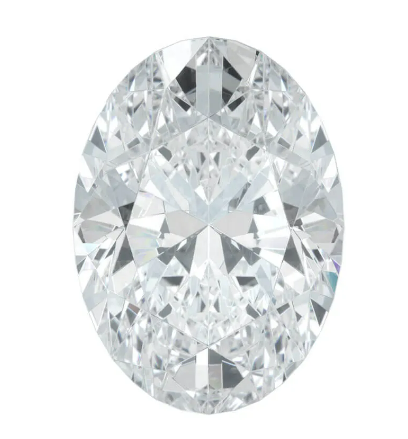





Oval-cut lab-grown diamonds: the short answer
Oval diamonds offer much of a round brilliant's sparkle with a larger-looking, elongated face. They flatter the finger and work in almost every setting. The feature to watch is the bow tie: a band of contrast across the center that can add definition or look distracting when it stays very dark.
Choose the outline first, then compare videos for brightness from end to end. F–H color and VS1–VS2 clarity are sensible starting points for many buyers, but an attractive oval matters more than paying for grades you cannot see.
We compare oval diamonds using their face-up videos, grading reports, measurements and live prices. Our recommendations also reflect Klaus and Juli's experience buying and returning diamond jewelry and inspecting settings in stores. For ovals, we place particular weight on the bow tie, outline and visible spread because none is fully captured by the headline grades.
What one-carat oval diamonds cost
We checked Ritani's one-carat inventory on September 11, 2026. A 1.00-carat D-color, VS1 oval with an IGI report cost $326. The table places that diamond beside lower-priced ovals and rounds with matching E color and VVS2 clarity.
| September 2026 comparison | Price |
|---|---|
| Typical price among five lower-priced 1-carat E/VVS2 ovals | $266 |
| Highlighted 1.00-carat D/VS1 oval | $326 |
| Typical price among five lower-priced 1-carat E/VVS2 rounds | $240 |
What is an oval-cut diamond?
An oval is an elongated brilliant cut with rounded ends. Its length-to-width ratio controls whether it appears broad or slender, while its facet arrangement creates a pattern similar to a round brilliant.
Modern oval brilliants are designed to return light through many triangular and kite-shaped facets. They generally look larger than rounds of equal weight because more of their surface stretches across the finger. The lack of pointed corners also makes an oval easier to protect than pear, marquise or princess cuts.
That combination—brightness, finger coverage and a soft outline—explains the shape's popularity. It also means inventories contain many different silhouettes. Two one-carat ovals can have the same grades and still look like different designs.
Oval diamonds have existed in different forms for centuries, but modern brilliant faceting made their light performance closer to that of a round. The shape became especially attractive for engagement rings because it combines a familiar brilliant appearance with a more individual outline.
The modern oval brilliant is commonly associated with cutter Lazare Kaplan's work in the late 1950s. Its popularity has risen and fallen since then, but the practical appeal has stayed the same: an oval can deliver brilliant-style sparkle and more visible length without the pointed ends of a marquise or pear.
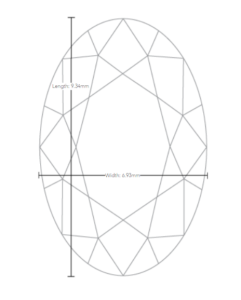
Oval-cut pros and cons
What we like
- Looks large for its carat weight
- Elongates the appearance of the finger
- Brilliant-style sparkle
- No exposed pointed corners
What to consider
- Every oval shows some bow-tie contrast
- Outline and ratio vary considerably
- Color can be more visible near the ends
- Cut quality cannot be reduced to one table or depth range
How to choose an oval lab diamond
Pick the outline and ratio
Many buyers prefer a ratio around 1.35–1.50, but there is no correct number. A 1.35 oval looks fuller; a 1.50 oval looks longer and slimmer.
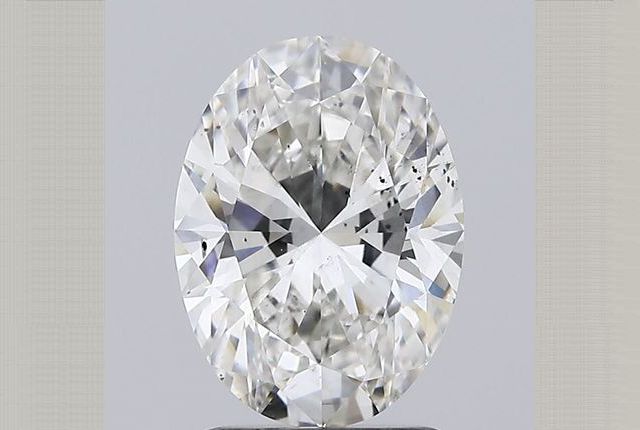
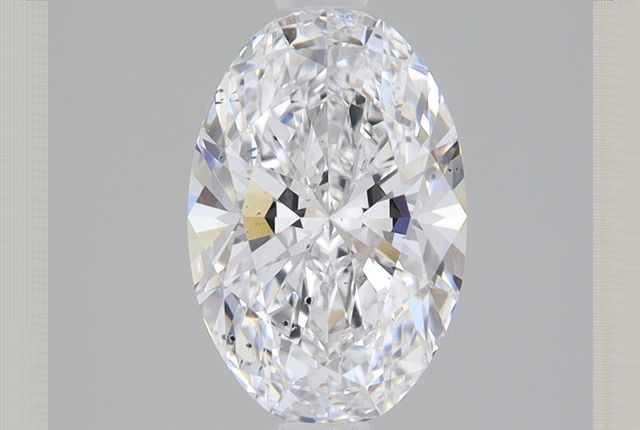
Compare the shoulders as well as the number. Some ovals are softly rounded, while others narrow more sharply toward the ends. Choose a balanced, symmetrical outline that suits the setting.
Very broad ovals can resemble rounded cushions, while very long ovals may look thin or show stronger central contrast. Check that neither end appears flat, pointed or mismatched. Ratio describes shape, not quality: an attractive 1.34 oval is better than a poorly proportioned 1.45 simply because the second number is popular.
Judge the bow tie in motion
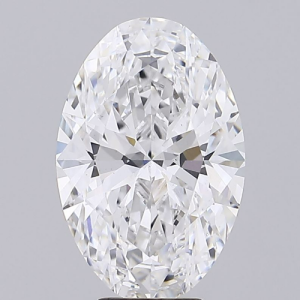
All elongated brilliant cuts show some bow-tie pattern. A light-to-moderate band can give the stone pleasing contrast. Avoid one that remains black and dominates the center through most of the video.
The bow tie comes from the way an elongated brilliant handles light and from what the diamond reflects around it. It may change when the stone or camera moves. A single still image can exaggerate or hide it, so compare videos at normal speed and pause at several angles. Look for brightness returning through the center rather than demanding that all contrast disappear.
Compare color, clarity and dimensions
F–H is a practical near-colorless starting range; the ends may show warmth before the center does. VS1–VS2 is often eye-clean, but inspect inclusions rather than buying by the grade alone. Compare length and width because two ovals of equal carat weight can face up differently.
An SI1 can be worthwhile when the video is clean and inclusions are small, pale and away from vulnerable areas. Conversely, a VVS grade does not guarantee good transparency or an attractive bow tie. Put the visible diamond before the rarity of the grade.
Carat weight has a nonlinear effect on price, and popular thresholds such as 1.00, 1.50 and 2.00 carats can attract premiums. A 0.90–0.99 or 1.40–1.49-carat oval may have nearly the same visual spread as the next threshold. Compare millimeters before paying for the number on the report.
For larger stones, color becomes easier to notice because there is more material and a longer outline to inspect. Yellow or rose gold can complement warmer grades; white metal creates more contrast with tint. Judge color in videos that do not use a heavily colored background.
Check the grading report
Confirm that the report identifies the diamond as laboratory-grown, then compare its measurements, polish, symmetry, fluorescence and clarity plot. The report helps you understand what you are viewing, but it cannot show whether the outline is attractive or the bow tie is distracting. Use it alongside the seller's video.
There is no GIA overall cut grade for oval diamonds. Table and depth ranges can narrow a very large catalog, but they cannot predict beauty by themselves. Start broadly, reject obviously deep stones with poor face-up spread, and let the video decide among the remaining candidates.
Watch for transparency and uneven ends
An oval can earn attractive color and clarity grades yet still look hazy or uneven. Compare how sharply the facets switch between light and dark as the stone turns. A crisp pattern usually looks livelier than a diamond whose center remains gray or whose ends appear watery.
Also compare both ends independently. They should have similar curvature and brightness. One flattened or darker end can make the entire outline look tilted even when the report gives the diamond a strong symmetry grade.
The best settings for an oval diamond
A four- or six-prong solitaire keeps the shape open and elegant. A hidden halo adds side detail, while a full halo makes the center look larger. Three-stone designs suit ovals particularly well. Make sure the stone sits straight: even slight rotation is easy to see.
Four prongs expose more of the outline; six can add security but may make a smaller oval look busier. A bezel protects the entire edge and gives the ring a modern appearance. East–west settings turn the oval across the finger and work particularly well with wider bands.
Before ordering, check the setting's band width and height, whether a wedding band will sit flush, and whether the prongs change the oval's apparent symmetry. An elongated center can rotate visually if it is not aligned precisely.
Oval jewelry and settings to compare
These current examples show an oval in studs, a protective bezel solitaire and a pavé hidden-halo ring. Compare total weight, center size and setting details—not price alone.
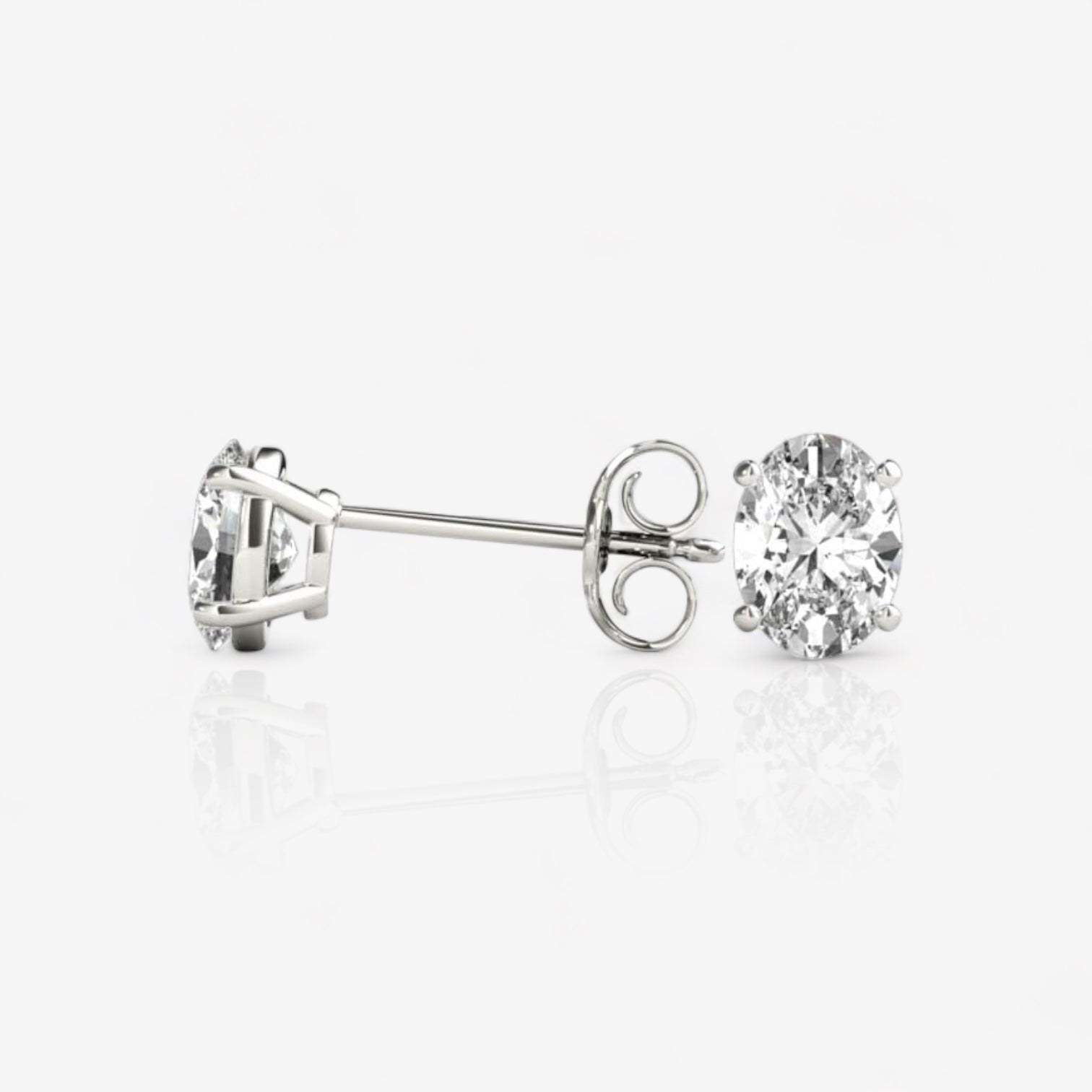
Ritani · Earrings
Lab-grown oval diamond stud earrings
- Oval lab-grown diamonds
- Made-to-order listing
- Several earring-back options offered
Oval studs give a longer outline than rounds. Ritani offers several back styles, so confirm the selected variant before checkout.
Price checked September 10, 2026.
See at Ritani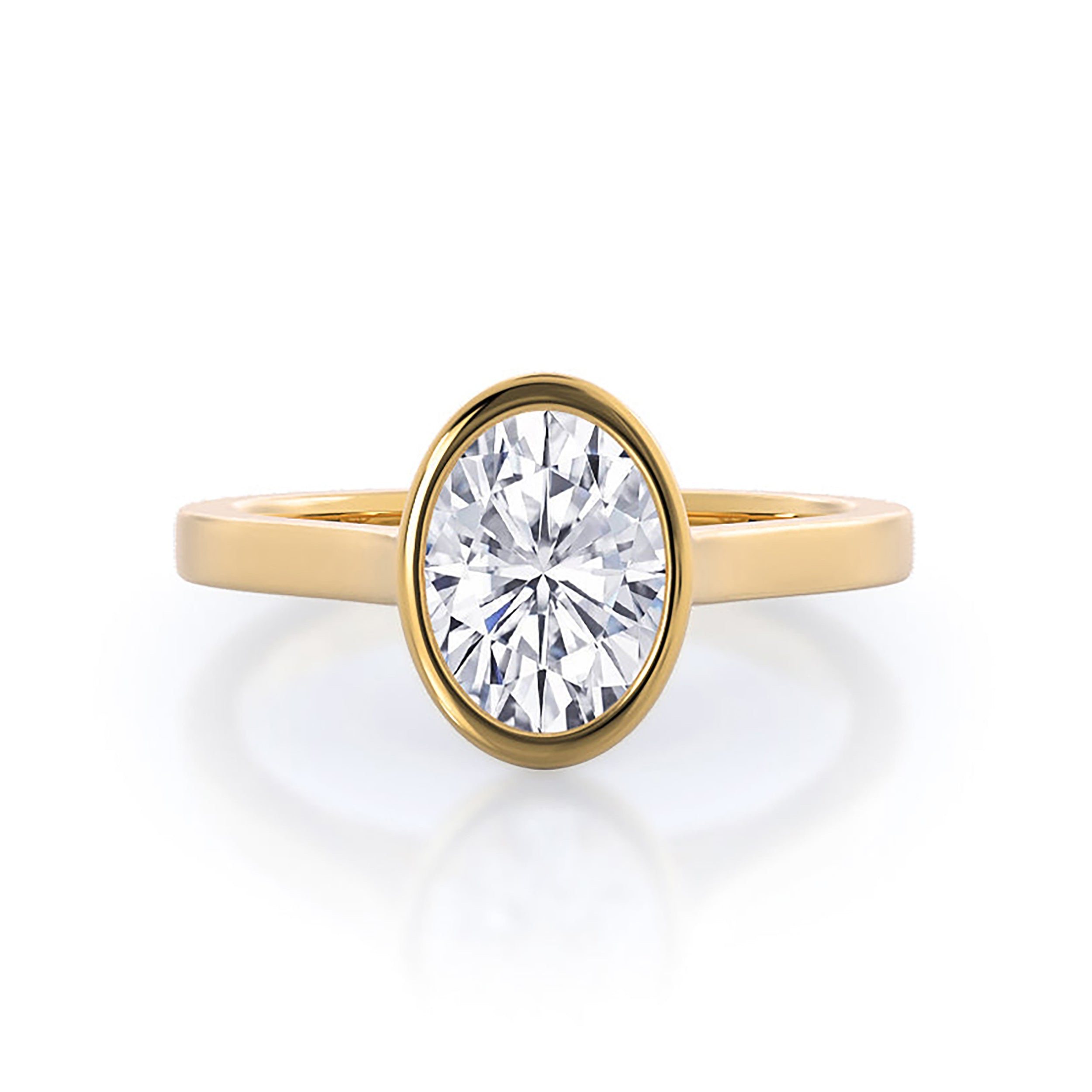
With Clarity · Engagement ring
Oval bezel-set lab-grown diamond solitaire ring
- 2 ct total weight
- Oval lab-grown center diamond
- 14K yellow gold
- Bezel setting
- Listed in size 6.5
The bezel outlines the oval diamond and gives the edge more protection than exposed prongs. Check the report, face-up measurements, and fit before buying.
Price checked September 2, 2026.
See at With Clarity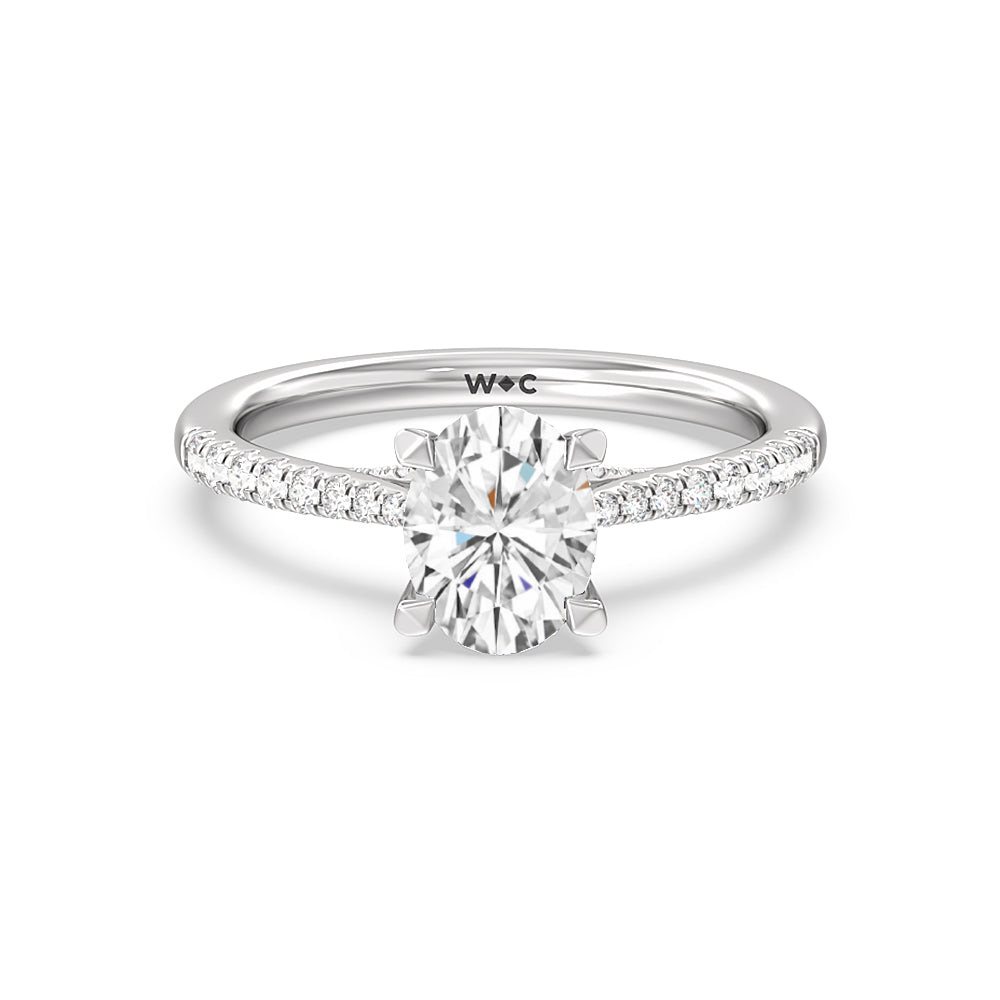
With Clarity · Engagement ring
Oval pavé lab-grown diamond ring with a hidden halo
- 2.20 ct total weight
- Oval lab-grown center diamond
- 14K white gold
- Pavé band and hidden halo
- Listed in size 6.5
This complete ring adds small diamonds along the band and below the center. Ask about resizing limits, small-stone cover, and wedding-band fit.
Price checked September 2, 2026.
See at With ClarityHow much does an oval lab diamond cost?
Among five of Ritani's lower-priced matching diamonds in September 2026, a typical one-carat oval cost $266, compared with $240 for a round. Every diamond was 0.95–1.05 carats, E color, VVS2 clarity and IGI graded. Ovals were slightly more expensive in this comparison, but the elongated shape can still look larger face-up.
Prices depend on the outline, cut, size, grades and seller. Compare several videos at the same specifications; the lowest price is not a bargain if the bow tie overwhelms the stone. See the full comparison in our one-carat lab-grown diamond price guide.
To save, compare diamonds immediately below common carat thresholds and avoid paying for color or clarity differences you cannot see. Lab-grown ovals are widely available, so there is usually no need to accept a poor outline merely to secure one report grade or sale price.
The apparent-size advantage is part of the value calculation. An oval does not always have a greater measured surface area than every round of equal weight, but its length gives it more finger coverage. Compare the actual millimeter dimensions and a hand-scale preview rather than relying on a generic claim that every oval looks a fixed percentage larger.
Caring for an oval diamond
An oval has no pointed corner, but its elongated girdle and setting still need protection. Clean it with warm water, mild dish soap and a soft brush, paying attention beneath both ends where residue gathers. Have the setting checked if a prong catches or the stone moves.
Remove an oval ring for lifting, gardening, sports and household cleaning. Store it separately from other diamonds and gemstones. A bezel offers strong edge protection; prong settings should hold the stone evenly so it cannot rotate.
Where to buy oval-cut lab-grown diamonds
Look for a seller that shows the actual diamond in motion and provides its grading report. Then compare the complete ring price, setting choice, service and return terms.
Start with Ritani for loose-diamond selection and price comparison. Brilliant Earth, With Clarity and Grown Brilliance are useful when the setting is central to the decision.
Oval catalogs are large, so use filters to create a shortlist rather than choosing the first stone with preferred grades. Compare several outlines and bow ties at once. The strongest seller is the one that combines useful video, a reliable grading report, fair complete-ring pricing and return terms that cover your chosen setting.
| Jeweler | Best for | Our rating | Shop |
|---|---|---|---|
| Ritani | Prices, loose-diamond selection and value | 4.7/5 | See at Ritani |
| With Clarity | Ring design, service and a guided buying process | 4.5/5 | See at With Clarity |
| Brilliant Earth | Premium settings, showrooms and guided shopping | 4.5/5 | See at Brilliant Earth |
| Grown Brilliance | Finished oval jewelry and design-led settings | 4.5/5 | See at Grown Brilliance |
Oval-cut FAQ
What is the best oval ratio?
There is no universal best. Roughly 1.35 looks broad and 1.50 looks elongated; choose the silhouette you prefer.
Is a bow tie bad?
Not automatically. Some contrast gives an oval definition. Avoid a bow tie that stays very dark or distracts from the rest of the diamond.
Does an oval look larger than a round?
Often, yes. Its elongated surface usually provides more visible finger coverage at the same carat weight. Compare actual length and width because depth and outline vary.
What clarity is best for an oval lab diamond?
VS1–VS2 is a comfortable starting range, but an eye-clean SI1 can offer excellent value. Inspect the video and inclusion position rather than paying automatically for VVS clarity.
Oval or round: which should I choose?
Choose oval for more visible length and a softer, elongated outline. Choose round when maximum standardization and a formal overall cut grade matter more. Both can be exceptionally bright.
Questions and experiences
Join the discussion
Ask a question or share your experience. We review comments before publishing them.