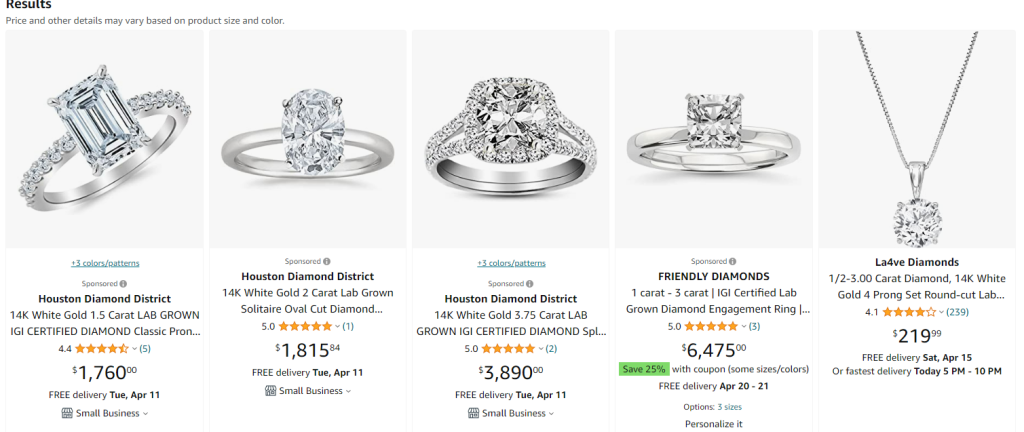





Amazon’s convenience does not automatically make it the best place to buy a lab-grown diamond. Our bottom line is that a specialist diamond jeweler is usually the better choice for an engagement ring or other expensive diamond purchase.
The problem is not the lab-grown origin. The problem is that marketplace listings often make it difficult to inspect the exact stone, open its grading report, compare proportions, understand who stands behind the product, or obtain advice from a diamond specialist.
We reached this conclusion by examining Amazon search results and individual jewelry listings, then comparing the information supplied with the exact-stone videos, grading reports, filters and support available from specialist jewelers. Klaus and Juli have also bought, returned and inspected lab-grown diamond jewelry, which informs the checks below.
| Check before buying | Why it matters |
|---|---|
| Image or video of the exact diamond | A stock photograph cannot reveal that stone’s inclusions, tint, or cut pattern |
| GIA or IGI report number | Lets you verify origin and reported quality characteristics |
| Complete specifications | Carat weight alone cannot establish quality or value |
| Named seller and warranty | Amazon hosts third-party sellers with different standards |
| Item-specific return terms | Marketplace return rules and exclusions can vary by seller |
| Like-for-like price comparison | A low headline price may reflect smaller total weight or lower grades |
The examples below illustrate the recurring issues we found when examining Amazon listings. Individual listings change, so judge the evidence supplied for the product in front of you.
Amazon uses diamond stock photos
Many Amazon diamond listings use generic product images rather than photographs or videos of the exact stone. That creates several problems:
Quality of diamond images
The quality of stock photos used on Amazon often leaves much to be desired. These images are often generic and do not accurately depict the actual appearance or characteristics of a specific lab-grown diamond being sold.
Without high-resolution images or videos of the actual diamonds, you cannot compare their visible inclusions, tint and light performance as confidently as you can with exact-stone imagery.
Lack of diamond information
Stock photos provide very little information about the actual lab-grown diamonds being offered for sale on Amazon. Without detailed images or descriptions, it’s nearly impossible for you to make informed decisions when purchasing these gems online.
Our best-rated places to buy lab-grown diamonds provide exact-stone information for loose diamonds, normally including magnified imagery or video and access to the diamond grading report.
Misleading diamond depictions
In some instances, stock photos may even misrepresent the true nature and quality of a particular lab-grown diamond available on Amazon. As a result, shoppers who rely solely on these images might end up with a product that doesn’t meet their expectations regarding size, color, clarity, or cut.
To avoid disappointment and ensure you’re getting exactly what you want when buying lab-grown diamonds, it’s crucial to have access to accurate visuals and comprehensive information about each gemstone’s specifications and origin – something sorely lacking when browsing through listings featuring only stock imagery.
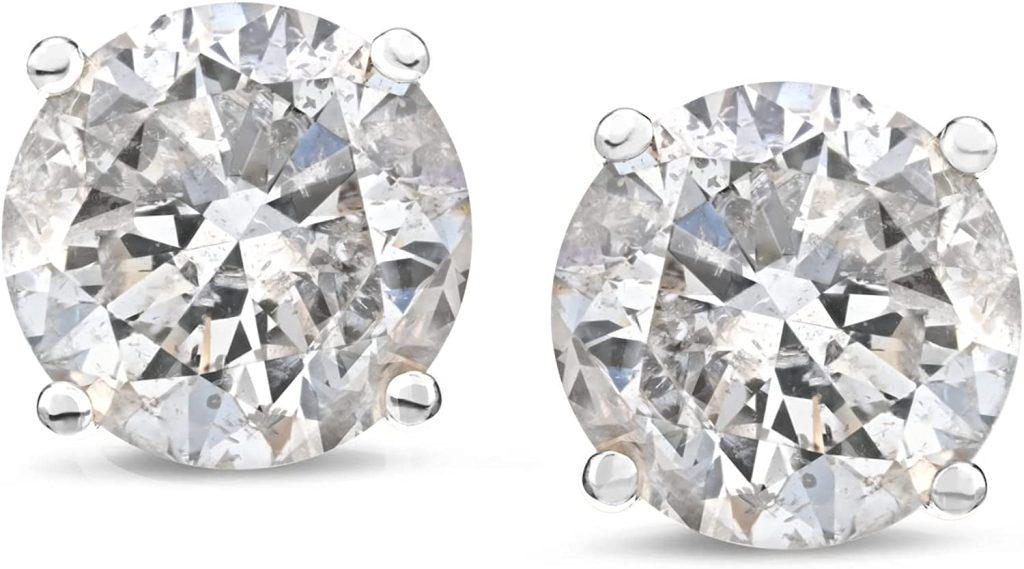
In this case, Amazon’s own brand shows what is probably an honest image of very low-grade lab diamonds. Don’t buy this!
Overall, the quality of stock photos on Amazon for lab-grown diamonds is lacking and often misleading. With this in mind, it’s important to understand what knowledge of lab diamonds is used when purchasing them online.
Diamond information on Amazon
When shopping for lab-grown diamonds on Amazon, one major concern is the limited information about the diamonds used in the jewelry. We have already touched on this in the previous section of our review of lab-grown diamonds on Amazon, not only the problematic images. As a buyer, you want to ensure that the lab-grown diamond you are buying meets your requirements and is accurately depicted and described.
Limited diamond information
The product descriptions for lab-grown diamond listings on Amazon often lack crucial details such as cut quality, clarity grade, color grade, and even carat weight! This can make it difficult to compare different options or determine if a particular diamond is worth its price tag.
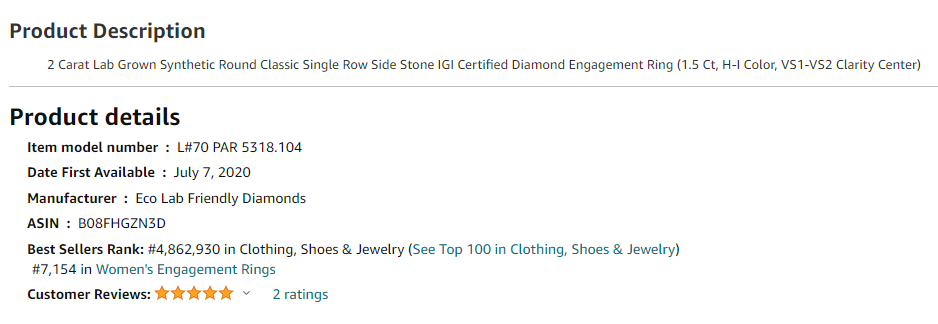
While color and clarity are mentioned, the seller is not listing the cut grade here or anywhere else on the listing.
Many listings do not provide a report number or a link to the diamond grading report. For a significant purchase, the report is important for checking the laboratory-grown origin, measurements and stated grades.
Unclear origin of diamonds
In addition to lacking detailed information about each diamond’s specifications, many listings do not disclose where their lab-grown diamonds are created or how they were created. Knowing this can help you understand more about the quality and ethical standards of diamond creation.
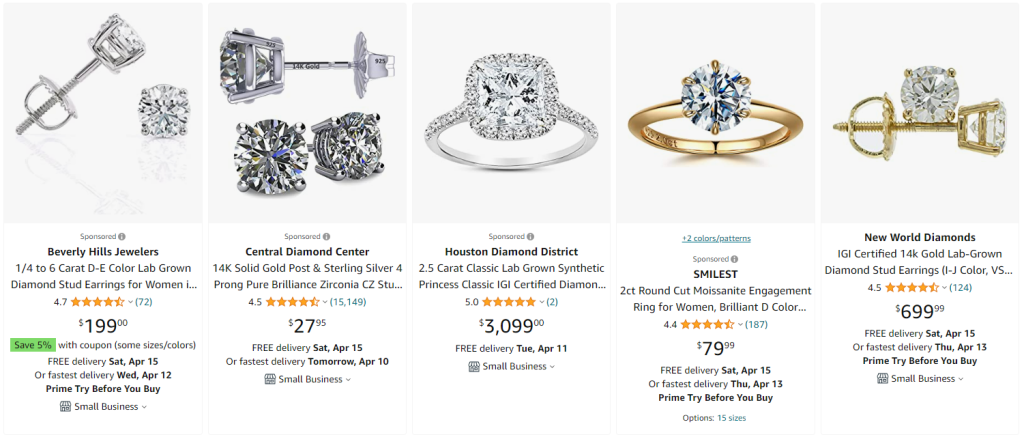
Thanks to Amazon’s recommendation algorithm, you might also see listings for non-diamond products, such as Cubic Zirconia and Moissanite.
Inability to choose your own diamond at Amazon
Unlike lab-grown diamond jewelers, who allow you to choose individual loose lab-grown diamonds based on specific criteria like cut, clarity, color, and carat weight (Blue Nile and its James Allen collection or Ritani, for example), Amazon does not offer this level of personalization when buying pre-set jewelry pieces with lab-created stones.
Choosing the loose diamond yourself gives you more control for an engagement ring or larger pair of earrings. You can balance cut, color, clarity and size for the setting instead of accepting a broad minimum grade. A well-specified preset piece can still be a good purchase, especially for smaller everyday jewelry.
Since you cannot choose your own lab-grown diamond on Amazon, there is no guarantee that the diamond used in your jewelry piece selected will meet your criteria or expectations.
In summary, when buying lab-grown diamonds on Amazon, customers are faced with limited information about the actual stones being used and an inability to select their preferred diamond based on specific criteria. These factors contribute to uncertainty regarding overall quality and value for money.
Assessing lab-grown diamond quality on Amazon
Quality varies across Amazon's many sellers. The recurring problem is that some listings do not provide enough evidence to judge cut, clarity, color or the weight of the individual diamonds.
Cut quality can be difficult to verify
The cut of a diamond is critical for determining its overall beauty and brilliance. A well-cut diamond will maximize light return and create an eye-catching sparkle that distinguishes it from lesser-quality stones. In fact, when considering brilliant-shaped lab-grown diamonds, you should value the diamond cut grade over anything else!
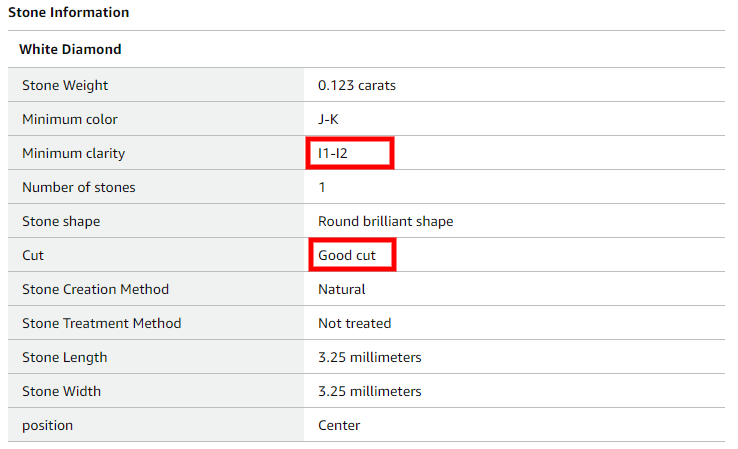
Listing details reveal both quality and origin: this example is labeled natural, with I1–I2 clarity and a seller's “Good cut” description.
Unfortunately, when purchasing lab-grown diamonds on Amazon, it is difficult to ascertain the quality of the cut due to a lack of information about the diamond cut grade, facets, and dimensions.
Some listings use words such as “Excellent” or “Ideal” without showing an independent grading report. Do not treat a seller's description as a laboratory grade. Ask for the actual report and check how cut is described there, alongside the proportions and measurements. Our grading-report guide explains the different report formats.
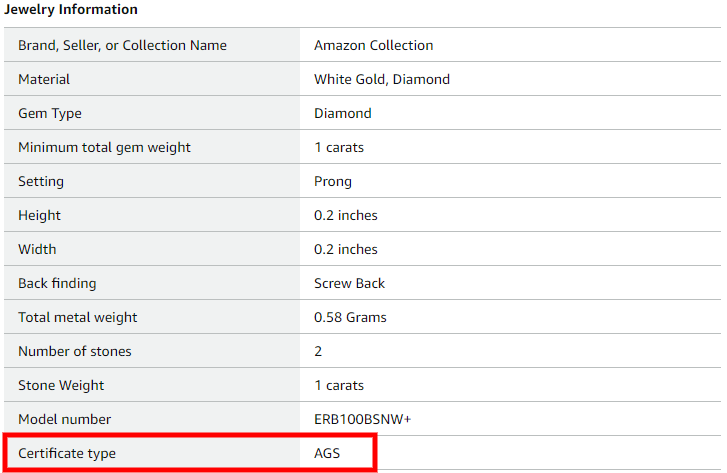
A grading claim is only useful when you can identify the laboratory, open the report, and match its number to the jewelry or diamond.
This lack of transparency makes it difficult to know if you’re getting a truly well-cut stone or just an average one with an alleged cut grade.
Color and clarity descriptions may be incomplete
Beyond cut quality, other factors such as clarity and color also play significant roles in determining a diamond’s value and appearance. Unfortunately, when browsing through lab-grown diamond listings on Amazon, you may notice vague descriptions regarding these important attributes – sometimes even missing entirely.
Diamond clarity is determined by the presence (or absence) of internal flaws known as inclusions and blemishes. These can impact how much light passes through your gemstone unimpeded by imperfections within its structure.
Diamond color grades (in colorless diamonds) tell you if a hue, typically yellowish, is present in the diamond and to what extent. For fancy-colored lab diamonds, it’s a little different, but these, too, are graded.
Without proper grading information from a reputable gemological laboratory, such as the Gemological Institute of America (GIA) or the International Gemological Institute (IGI), it’s difficult to determine if you’re getting a high-quality lab-grown diamond or one with noticeable inclusions and color tinting.
Low carat-weight options
Another drawback when buying lab-grown diamonds on Amazon is the limited range of carat weights. While some larger lab diamonds are available, many listings only offer smaller sizes that may not meet your needs, particularly for engagement rings or other significant jewelry pieces.
This lack of variety can make it hard to find the perfect diamond. In contrast, lab-grown diamond jewelers often provide much more extensive selections and customization options so you can choose the exact size, shape, and diamond grades that suit your needs best.
Purchasing a low-grade diamond can be an expensive blunder, so it’s essential to consider cost and value for money when selecting one. When shopping on Amazon, you should consider factors such as transparency in pricing, quality assurance guarantees, and carat weight options before deciding which diamond is right for you.
When buying lab-grown diamonds on Amazon, check cut quality, color, clarity, carat weight, and the grading report. Without those details, you cannot make a reliable quality or price comparison.
Lab-grown diamond prices on Amazon
Price is difficult to judge when a listing omits the grading report, exact diamond weight or full quality range. Compare the complete specification—not only a similar-looking photograph—with a specialist jeweler's current price.
Prices for lab-grown diamonds on Amazon are high.
In the listings we examined, Amazon did not consistently provide better value than specialist lab-grown diamond jewelers. A piece that looks inexpensive may have a lower total carat weight, broad grade range or no independently verifiable report. Compare like for like before assuming the marketplace price is lower.
Lab diamond prices on Amazon are not transparent.
In addition to lab diamonds often being more expensive on Amazon, there is a lack of transparency when pricing on Amazon listings. As highlighted before, many sellers fail to list detailed diamond quality data, making it difficult for shoppers to assess lab-grown diamond prices on Amazon accurately.
Lacking authenticity and certificates
As we have also mentioned above, a significant concern when buying lab-grown diamonds on Amazon is the lack of guarantee regarding quality and authenticity. While some sellers may claim to offer certified diamonds, there’s no way for customers to verify this information easily.
In contrast, reputable online diamond jewelers in lab-grown diamonds always provide detailed certification from well-known laboratories like IGI or GIA, ensuring that you receive accurate and independent information about the diamonds you are considering.
While Amazon might seem like a convenient option for purchasing lab-grown diamond jewelry, it falls short in terms of pricing transparency and value for money compared to other places. You should be cautious when considering buying on the platform due to potentially higher prices, vague product descriptions, and a lack of verifiable independent diamond grading reports.
Amazon diamond customer service and support
Unfortunately, when purchasing lab-grown diamonds on Amazon, you may also encounter issues with their customer service that can negatively impact your overall experience.
Limited customer service knowledge about lab-grown diamonds
The availability of knowledgeable customer service representatives specializing in lab-grown diamonds is limited on Amazon. As a result, getting accurate information about diamonds or addressing any concerns related to your purchase becomes challenging. In contrast, dedicated lab-grown diamond retailers usually offer personalized assistance from experts in the field, including virtual appointments with gemologists.
Return terms depend on the seller
Amazon hosts products sold by different businesses, and item-specific return conditions can vary. Read who sells and fulfills the item, the return window, and any exclusions for resized, engraved or custom jewelry before buying.
In contrast, our highest-rated lab diamond jewelers all offer more straightforward return processes and better guarantees for their products as they understand how important trust and satisfaction are in this industry.
Purchasing high-quality lab-grown diamonds requires thorough research and attention to detail – which may not be possible on shopping platforms like Amazon. To ensure you get the best value for your money and a satisfying shopping experience, consider exploring other lab-grown diamond retailers that specialize in providing high-quality diamonds, personalized customer service, and transparent pricing.
So, should you buy diamonds on Amazon?
We would not use Amazon for an important loose diamond or engagement-ring purchase unless the listing supplies the exact-stone evidence, grading report, seller identity, and return protection we expect from a specialist. Amazon can be convenient for modest pre-set jewelry, but compare total carat weight, grades, warranty, and the direct seller price first.
What if a recognized jeweler sells through Amazon?
A known brand name is more reassuring than an unidentified marketplace seller, but compare the Amazon listing with the jeweler’s own website before buying. The direct site may provide the exact grading report, better filtering, more complete service information, and a clearer route to warranty support.
Grown Brilliance, Friendly Diamonds, and New World Diamonds have all sold through marketplaces or their own storefronts. Their offerings and marketplace availability can change. Read our Grown Brilliance review, Friendly Diamonds review, and New World Diamonds review before treating the brand name alone as enough information.
For an important purchase, we would compare the brand’s direct price and terms with our recommended lab-grown diamond jewelers.
Buying Lab-Grown Diamonds on Amazon FAQs
Is there anything wrong with buying a lab-grown diamond?
No. Lab-grown diamonds are real diamonds with the same carbon crystal structure and everyday durability as mined diamonds. The buying risk comes from incomplete product information or an unreliable seller, not from laboratory-grown origin.
Does Amazon sell real diamonds?
Yes. Amazon listings can offer real mined and lab-grown diamonds, but the marketplace also contains moissanite, cubic zirconia, and products with incomplete descriptions. Look for an independent GIA or IGI report and confirm that the report number and specifications match the item being sold.
Questions and experiences
Join the discussion
Ask a question or share your experience. We review comments before publishing them.