




The bottom line: where should you start?
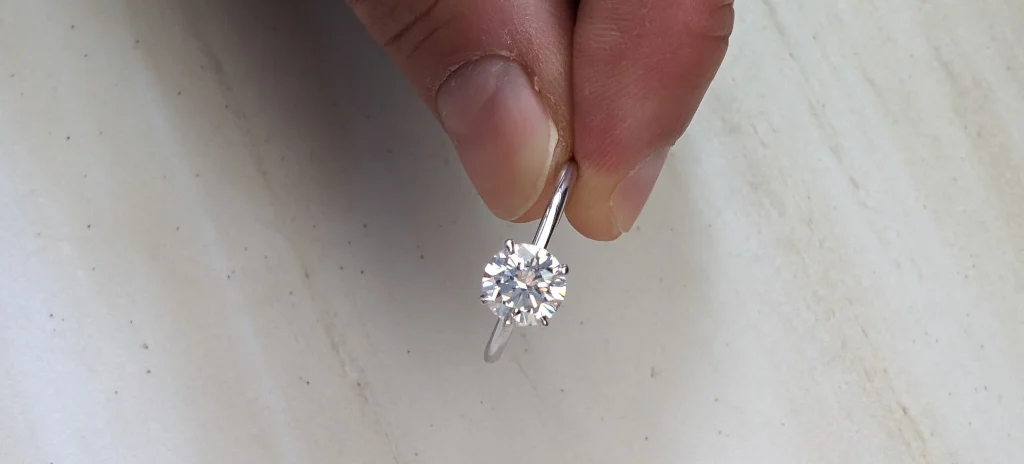
If your main goal is to pay less for a loose lab-grown diamond, start at Ritani. It was the cheapest seller in our latest test by a wide margin and has repeatedly performed well in our price comparisons.
The other four sellers in our price-based top five were Clean Origin, Brilliance.com, With Clarity, and Grown Brilliance. That does not mean they are our five highest-rated jewelers. A cheap diamond can come with weaker images, less helpful information, a limited setting choice, or policies that do not fit your order.
Here is the short version:
- Ritani: lowest loose-diamond prices and the best price transparency.
- Clean Origin: second-cheapest sample and a 60-day return window, but weaker diamond imagery in our latest check.
- Brilliance.com: competitive after its public discount code, with a large selection and a more complicated return policy.
- With Clarity: good ring builder, custom work, and Home Preview, though its sale price was well above Ritani.
- Grown Brilliance: our favorite of the five for distinctive finished jewelry, but not for the cheapest loose stone.
Visit Ritani Read our Ritani review
The cheapest sellers in our 2026 price test
We compared round lab-grown diamonds close to two carats, with E color, VVS2 clarity, IGI grading, and each seller's highest suitable cut label. The stones were close, not identical. Prices and stock change every day, so use this as a starting point and repeat the comparison for the diamond you want.
| Rank | Seller and sample | Price | Our current review score |
|---|---|---|---|
| 1 | Ritani: median of five 1.95 ct results | $422 | 4.7/5 |
| 2 | Clean Origin: 2.01 ct, sale price | $694 | 3.7/5 |
| 3 | Brilliance.com: 2.07 ct after public code | $924.70 | 3.9/5 |
| 4 | With Clarity: 1.97 ct, sale price | $1,063 | 4.5/5 |
| 5 | Grown Brilliance: 2.05 ct | $1,615 | 4.5/5 |
| 6 | Blue Nile: median of five close results | $1,782 | 4.6/5 |
| 7 | Brilliant Earth: 2.00 ct | $2,100 | 4.5/5 |
Ritani's five qualifying diamonds were $421, $422, $422, $422, and $422. Using the median helps avoid building the comparison around one unusually cheap listing. Where we could not collect five close results, we used the closest useful sample and say so in the table.
The comparison also shows why price and review score should be read together. Blue Nile and Brilliant Earth cost much more in this test, but both offer a more polished experience, physical showrooms, strong diamond inspection tools, and better design choices than a price-only ranking suggests.
Affordable diamonds without a bad purchase
Lab-grown diamond prices have fallen dramatically since we started this site in 2020. That is good news for buyers, but it has made the market harder to read. Two diamonds with the same headline grades can still differ in cut, proportions, tint, growth marks, treatment, and the quality of the video or grading information supplied.
The goal is not to find the lowest number on a search page. It is to find the lowest price for a diamond you have enough information to judge, from a seller whose setting and policies work for you.
We would rather pay a little more for a well-cut diamond with a real video and a readable report than save $50 on a stone we cannot inspect. We would not, however, pay four or five times as much for similar headline specifications without a clear reason.
1. Ritani: cheapest overall
Ritani remains our first stop for a loose lab-grown diamond. It combines very low prices with a huge searchable inventory, real diamond media on many listings, and the clearest price breakdown we have seen.
In our August 31, 2026 search, the five lowest qualifying results had a median price of $422. The product page for the $421 stone also showed Ritani's stated diamond cost, fulfillment cost, markup, and final price. That makes it easier to see what you are paying for.
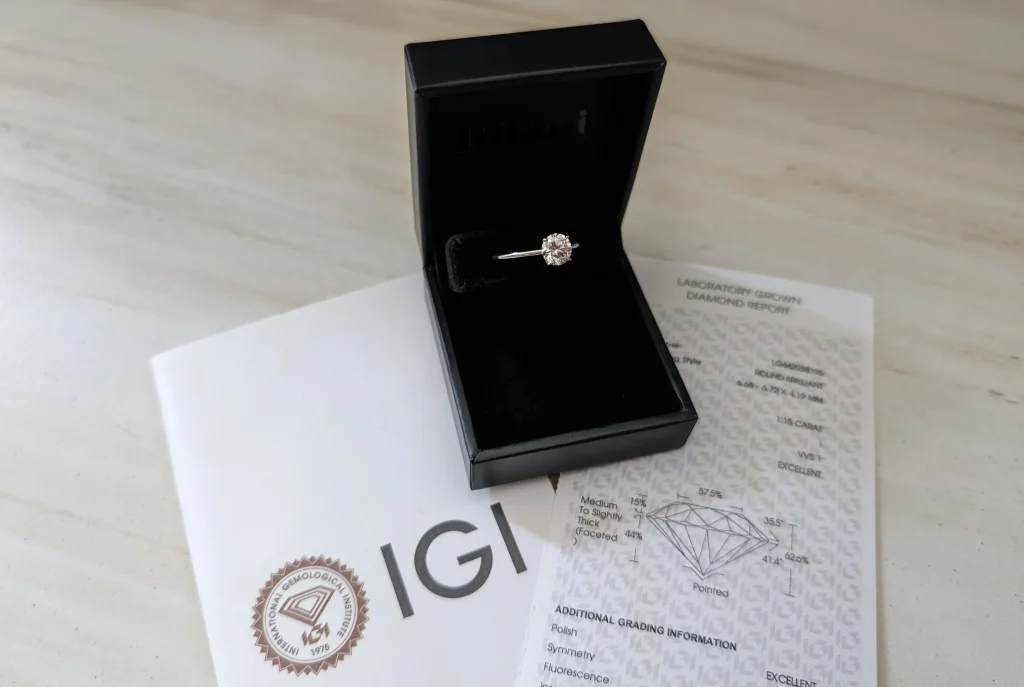
Ritani is not perfect. Its settings are less distinctive than those at Grown Brilliance or Brilliant Earth, and some of its public policy pages do not agree on shipping, returns, and its Diamond Pro preview. Confirm the terms for your order before paying.
Best for: buyers who want the lowest likely price on a loose lab-grown diamond and are comfortable comparing reports, videos, and measurements.
Visit Ritani Read our Ritani review
2. Clean Origin: low sample price, but compare the diamond page
Clean Origin's 2.01-carat sample was $694 after a 25% promotion. That was 64.5% above the Ritani median, but still cheaper than the other five sellers in our wider comparison.
The company has a large selection, six US stores, and a generous 60-day return window. We have also bought and returned jewelry from Clean Origin, and that experience went smoothly.
The drawback in our September 2026 check was the diamond page. The sample used a generic round-diamond image instead of showing the exact stone. For an important center diamond, ask for a real high-resolution video before ordering. If Clean Origin cannot supply one, choose another stone or another seller.
Best for: shoppers who value a longer return window or live near a Clean Origin store, provided they can inspect the actual diamond before buying.
3. Brilliance.com: competitive after the discount
Brilliance.com's 2.07-carat sample cost $924.70 after the public promotion shown during our test. That made it the third-cheapest seller in this particular comparison.
Brilliance.com has a large loose-diamond inventory and enough filters to find close matches. Its value is less consistent than Ritani's: some stones compared well, while others did not. The return rules also need more attention because fees and exclusions can depend on the order and the reason for the return.
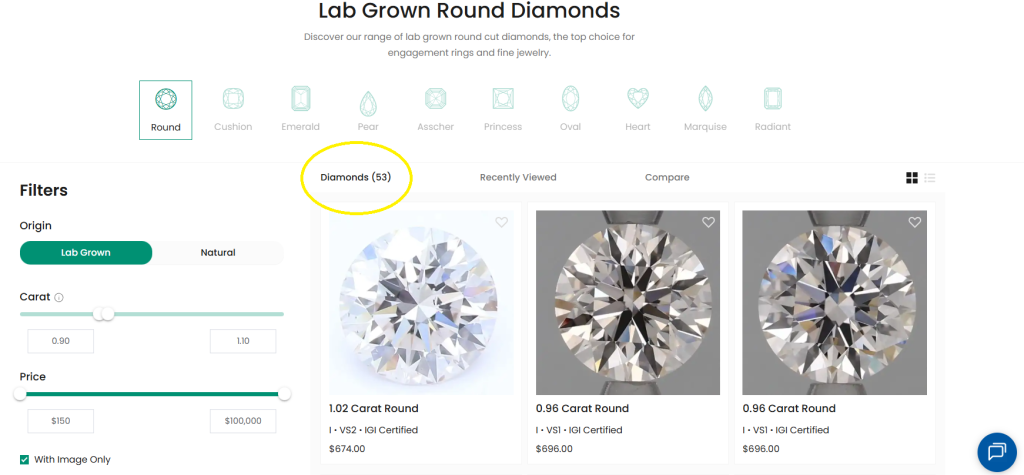
Best for: buyers willing to compare individual listings closely and read the return terms before ordering.
Read our Brilliance.com review
4. With Clarity: better for the complete ring than the loose-diamond price
With Clarity used to place near the top of our price comparisons. In September 2026, its 1.97-carat sample was $1,063 after a 25% discount. That was more than twice the Ritani median.
Price is not the only reason to consider With Clarity. We used its Home Preview service and later bought a custom engagement ring from the company. The ring builder is easy to use, the finished ring was excellent, and the custom process gave us more control than a basic online setting menu.
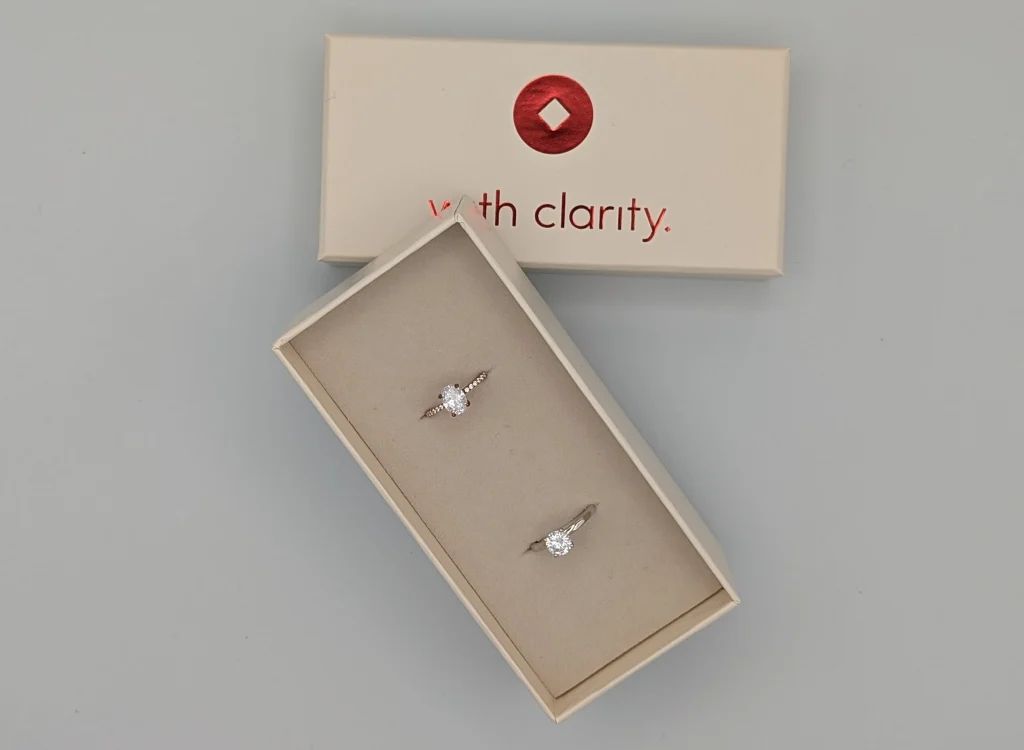
Home Preview now works differently from the free program described in the first version of this article. You pay $200 for each replica ring, can try up to two for seven days, and receive the payment as a gift card after returning them.
Best for: engagement-ring buyers who value the ring builder, custom design, and the option to try replica settings at home.
Visit With Clarity Read our With Clarity review
5. Grown Brilliance: best for finished jewelry and design
Grown Brilliance's 2.05-carat sample was $1,615, almost four times the Ritani median. It made the price-based top five, but we would not choose it for a loose diamond on price alone.
We recommend Grown Brilliance for a different reason: its finished jewelry is among the best in the category. We have bought several pieces, including a pendant, an eternity ring, and a heart necklace. The designs, presentation, and ring builder are much stronger than the standard catalog found at many discount-focused sellers.
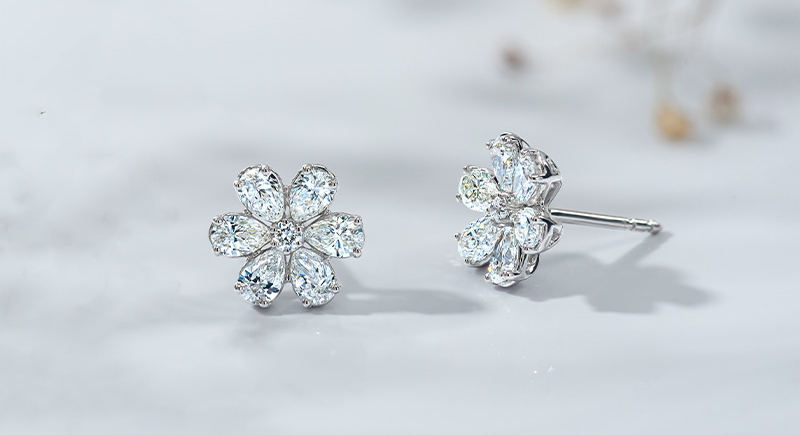
The loose-diamond search also starts at high color and clarity grades. That keeps the visible quality high, but it removes some of the lower-cost G, H, and eye-clean clarity combinations that can offer better value.
Best for: buyers who care more about the complete ring or jewelry design than finding the absolute cheapest center stone.
Visit Grown Brilliance Read our Grown Brilliance review
Other jewelers worth comparing
Blue Nile
Blue Nile was not cheap in our loose-diamond test: the median of five close results was $1,782. We still rate it 4.6/5 because the overall experience is excellent. Its current lab-grown range includes the former James Allen collection, and you get strong inspection tools, established service, and access to physical showrooms.
If you prefer Blue Nile, compare the exact loose diamond at Ritani before ordering. The premium may make more sense for a setting you love than for an easily compared loose stone.
Visit Blue Nile Read our Blue Nile review
Brilliant Earth
Brilliant Earth was the most expensive seller in our test at $2,100. It remains one of our highest-rated premium jewelers because its designs, 43 US showrooms, service, and sustainability choices stand out.
It is best for buyers who value those benefits over higher prices. If price comes first, buy the loose diamond elsewhere or ask Brilliant Earth to help find a closer match.
Visit Brilliant Earth Read our Brilliant Earth review
What happened to James Allen?
James Allen was one of our five recommendations and often combined good prices with the best diamond videos and support. It is no longer a standalone store. Its collection now sits inside Blue Nile, so we compare Blue Nile as the active retailer.
Read what happened to James Allen
Tips for buying a cheaper lab-grown diamond
Put cut before the grades people cannot see
Cut has the greatest effect on how a diamond handles light. For a round diamond, start with a strong cut grade and sensible proportions. Do not give up a lively, well-cut stone just to move from VS2 to VVS1 clarity when both look clean without magnification.
Compare the measurements, not only the carat weight
Carat measures weight, not visible size. Two diamonds of the same carat can face up differently. Check the millimeter measurements and depth before paying more for a heavier stone that may not look larger.
Look just below popular carat marks
A 0.90- to 0.99-carat diamond can cost less than a one-carat stone and look almost the same size. The same idea can work just below 1.5 or two carats. It is a useful tactic, not a rule; compare the face-up measurements and cut.
Use color and clarity where they matter
G or H color can look excellent in many settings, especially yellow or rose gold. VS2 is often eye-clean, and some SI1 stones can be too. The video matters more than the label once you move below the very highest grades.
Check the complete ring price
The cheapest loose diamond does not guarantee the cheapest finished ring. Settings vary in metal weight, side stones, craftsmanship, resizing rules, and warranty coverage. Compare the final cart, not just the center stone.
Never buy an important stone from a sample image
Look for a real video of the exact diamond. Check for tint, visible inclusions, dark areas, uneven growth, and anything that does not match the grading report. If the seller only shows a stock image, ask for the actual media.
Quality and lab-grown diamond prices
Lab-grown diamonds are real diamonds. They have the same basic crystal structure and physical properties as mined diamonds, but they are produced in a factory rather than extracted from the ground.
Their lower price does not automatically mean lower quality. It reflects a very different supply chain and a market in which production has grown quickly. The trade-off is that lab-grown diamonds usually have weak resale value and prices can continue to fall. Buy one for the jewelry and the savings, not as a financial investment.
The price of a loose stone still depends on:
- carat weight and visible dimensions;
- cut, proportions, and shape;
- color and clarity;
- grading laboratory and report details;
- growth quality and any post-growth treatment;
- the seller's markup, service, and return costs.
For a closer look at current sizes, see our lab-grown diamond price guides.
Buying online vs. in a store
Online sellers usually offer more diamonds and lower prices because they can list supplier inventory without stocking every stone in a showroom. You can compare several reports and videos side by side without a salesperson waiting for an answer.
The drawback is obvious: you cannot see the diamond in person before ordering. Good video, a grading report, and a usable return policy reduce that risk.
Stores still have a place. Brilliant Earth and Blue Nile have showroom networks, Grown Brilliance has boutiques, and Clean Origin has six stores. Ritani offers Diamond Pro previews for eligible orders. With Clarity has a New York showroom and its at-home replica program.
Our usual approach is to research and compare online, then use a showroom or preview when the setting is hard to judge from photographs.
Understanding lab-grown diamonds
Lab-grown diamonds are made mainly with chemical vapor deposition (CVD) or high pressure, high temperature (HPHT). Both methods create diamond crystal. Neither method guarantees a beautiful stone; the finished diamond still needs good growth, cutting, and polishing.
The easiest way to avoid confusion is to check that the listing and report clearly identify the stone as laboratory-grown. A lab-grown diamond is not cubic zirconia or moissanite. Those are different materials used as diamond alternatives.
If you are new to the subject, start with what lab-grown diamonds are and our plain-language guide to the diamond 4Cs.
Sustainability and ethical claims
Lab-grown diamonds avoid diamond mining, but that does not make every lab-grown stone equally sustainable. Growing diamonds uses a great deal of electricity, and the result depends on the energy source, the factory, and what the seller can document.
Be careful with broad claims such as “eco-friendly” or “carbon neutral.” Look for details that apply to the exact diamond or collection. Brilliant Earth, for example, separates selected lab-grown diamonds into Renewable Energy, Capture, and Sustainably Rated collections. Those labels do not apply to every stone on its site.
Lab-grown diamonds also avoid the direct mining risks associated with the center stone, but a finished piece still contains metal and may include other gems. Ask about recycled metal, supplier standards, and traceability if those issues matter to you.
Certification and grading in 2026
Most loose lab-grown diamonds we see online still carry IGI reports with familiar color, clarity, carat, polish, symmetry, and cut information. Open the report and make sure its number matches the listing and the laser inscription when one is shown.
GIA changed its service for colorless-to-near-colorless lab-grown diamonds in October 2025. New GIA assessments use Premium or Standard instead of the natural-diamond color and clarity grades used on older GIA lab-grown reports. Premium requires D color, VVS clarity or better, and Excellent finish and cut criteria; Standard covers a wider qualifying range.
This means two legitimate reports can look very different in 2026. Do not reject an older GIA report or an IGI report simply because it uses the 4Cs, and do not treat the word Premium as a substitute for reading the measurements and inspecting the diamond.
How we compared the cheapest jewelers
For the 2026 price test, we searched the US versions of seven seller sites between August 30 and September 1. We looked for round lab-grown diamonds close to two carats, E color, VVS2 clarity, IGI grading, and the seller's highest suitable cut label. We sorted by price and used the median of five low qualifying results at Ritani and Blue Nile. At the other sellers, we used the closest useful sample available during the check.
The comparison is a market snapshot from August and September 2026. Seller cut labels are not interchangeable, the reports and proportions were not identical, and some prices included public promotions. Those differences are why we show the search criteria, full review scores and what each seller does well—not only the lowest number.
Further reading
- Our Ritani price test and review
- Our Clean Origin price test and review
- Our Brilliance.com price test and review
- Our With Clarity price test and review
- Our Grown Brilliance price test and review
- Our Blue Nile price test and review
- Our Brilliant Earth price test and review
- GIA laboratory-grown diamond services
- GIA's October 2025 assessment change
FAQs about cheap lab-grown diamonds
Where is the cheapest place to buy a lab-grown diamond?
Ritani was the cheapest seller in our August 2026 comparison. Its five lowest qualifying results had a median price of $422, well below the closest samples at the other six sellers.
Why are Ritani's lab-grown diamonds so cheap?
Ritani competes aggressively on loose-diamond price and lists a large supplier-fed inventory. Its product pages also show what Ritani says it paid for the stone, the fulfillment cost, its markup, and the final price.
Are cheap lab-grown diamonds real diamonds?
Yes. Price does not decide whether a stone is a diamond. Check that the listing and grading report identify it as laboratory-grown, then judge its cut, color, clarity, measurements, and actual video.
Is the cheapest diamond always the best value?
No. A slightly more expensive stone can be a better buy if it has better cut, clearer information, a real video, or more suitable return terms. Compare the complete ring and the risks of the purchase, not only the first number in the search results.
Which lab-grown diamond grades offer the best value?
There is no single combination for every shape and setting. For many buyers, a strong cut, G or H color, and an eye-clean VS2 diamond offer a better balance than paying for grades that are difficult to see. Use the video and measurements to decide.
Should I buy a lab-grown diamond online?
Usually, yes. Online sellers offer far more choice and often lower prices. Buy from a seller that shows the actual diamond, supplies a reputable report, ships securely, and gives you enough time to inspect and return the order.
Conclusion: the cheapest place to buy in 2026
Ritani is the clear place to start. It was cheapest in our latest test, has repeatedly performed well in past comparisons, and gives buyers unusually clear price information.
Then compare based on the rest of the purchase. Clean Origin may suit a buyer who wants 60-day returns or a nearby store. Brilliance.com can be competitive when its public discount applies. With Clarity is stronger for ring building and custom work. Grown Brilliance is the best design choice among the price-based top five.
Do not stop at the headline grades. Open the report, inspect the real diamond video, compare the measurements, and read the return terms. That is how you turn a cheap price into a good purchase.
Questions and experiences
Join the discussion
Ask a question or share your experience. We review comments before publishing them.