





Can you still create lab-grown diamond earrings at James Allen?
You can still buy James Allen earrings, but the standalone JamesAllen.com store has closed. James Allen is now a collection at Blue Nile. If you want to choose the individual diamonds yourself, Blue Nile also has a Design Your Own Earrings builder with lab-grown diamond pairs.
These are two different shopping choices. A finished pair from the James Allen collection gives you an existing design with diamonds already selected. Blue Nile's builder lets you choose two loose diamonds and a compatible setting; the finished earrings are not necessarily part of the James Allen collection.
Our advice: use the builder if cut quality and choosing the exact stones matter most to you. Consider a preset pair if you prefer a simpler purchase and are happy with the diamonds and details listed. Compare the complete price, including the settings, before deciding.
Read our James Allen review Shop James Allen at Blue Nile
Build the pair in three steps: choose your diamonds, choose your earrings, and complete the order. Our shopping screenshots and purchase experience show which details matter at each step.
Why we chose our own diamonds
With preset earrings, you choose a style, metal, and carat weight, but the seller chooses the diamonds. That is convenient. The drawback is that a product page may list only a color and clarity range, without showing the cut grade or a report for each stone.
Cut matters because it affects how a diamond handles light. A high color or clarity grade alone does not guarantee a bright, lively pair of earrings.
We learned this when we bought lab-grown diamond studs from James Allen. The first, preset pair looked attractive but did not sparkle as much as we hoped in some lighting. We returned them and chose two round lab-grown diamonds ourselves: 0.30 carat each, D color, VS1 clarity, and IGI graded, in a bezel setting.
James Allen provided an insured return label and processed the exchange within a week. Our custom replacement arrived before Christmas, and the difference in sparkle was striking. That purchase and return are described in more detail in our James Allen review.
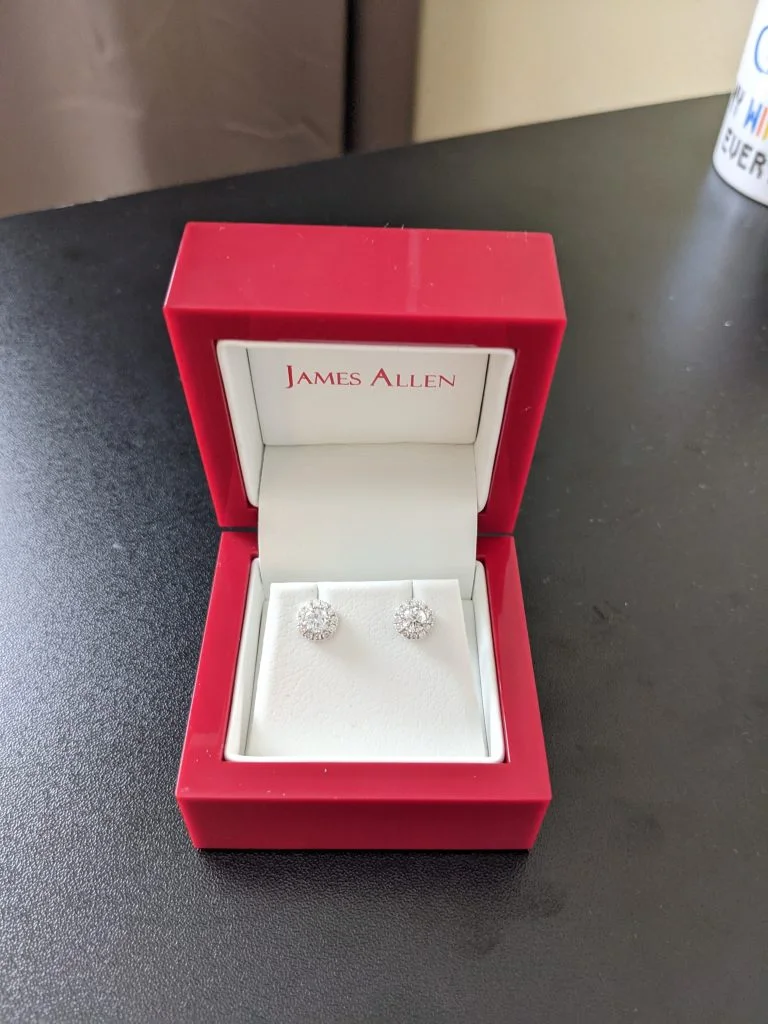
This does not mean every preset pair is poor quality or every custom pair is better. Choosing the stones gave us more control, and that is the part of the experience we still recommend.
Step 1: Choose your diamonds
On Blue Nile, open Earrings → Design Your Own Earrings → Start with Diamonds, then select Lab-Grown. Check that the results actually say lab-grown; the builder also sells natural diamond pairs.
You can also start with a setting if you already know which style you want. Either way, you need two stones that look good together, not simply two diamonds with impressive grades.

Decide on the total carat weight
Earrings are usually advertised by total carat weight, often written as CTW or CTTW. For a pair of solitaire studs, that is the combined weight of the two diamonds.
| Total weight of the pair | Approximate weight in each ear |
|---|---|
| 0.60 carat | 0.30 carat |
| 1 carat | 0.50 carat |
| 1.50 carats | 0.75 carat |
| 2 carats | 1 carat |
For halo or cluster earrings, the advertised total may include the smaller surrounding diamonds too. Check the center-stone weights separately.
Blue Nile labels its pair-search filter Carat (Total), while the results show each diamond's weight. A two-carat pair is not two carats in each ear.
Our own 0.60-carat pair suited the smaller, everyday studs we wanted. Your choice may be different. Compare the millimeter measurements to earrings you already wear, and leave room in your budget for the settings. Our one-carat diamond price guide covers a single stone, not the price of a complete one-carat pair.
Choose a shape
We chose round brilliant diamonds for our earrings. They give a classic stud look and are a straightforward starting point when sparkle is the priority.
Other options include oval, princess, cushion, emerald, pear, radiant, Asscher, marquise, and heart shapes. With elongated shapes, pay particular attention to the outline and length-to-width ratio so one earring does not look noticeably longer or narrower than the other.

Diamond cut: put sparkle first
For round studs, start with a top cut grade, then inspect the individual stones. Look at the grading report as well as the seller's label. Blue Nile's current results include IGI-graded round diamonds labeled Ideal; its filter labels are not a substitute for reading the report.
We would reduce size or relax an unnecessary color or clarity grade before accepting a visibly dull diamond. But “Ideal” alone is not a complete assessment: the images, proportions, and appearance of both stones still matter.
Our diamond cut guide explains the basics. For fancy shapes, also watch for uneven brightness, distracting dark areas, or a watery-looking center.
Diamond color: match the pair
On the familiar D–Z scale, D is the highest color grade. You do not need D color for attractive earrings, even though that is what we bought.
F–H is a useful starting range for white-looking lab-grown studs. I or J can work if you like a warmer appearance, particularly in yellow or rose gold, but do not assume the metal will hide every tint. Larger stones and some shapes show color more readily.
The important thing is that the two diamonds look similar. Prefer the same color grade, then check their images together. Two diamonds with the same grade can still show different tints.
Compare actual prices before lowering your color requirements. With today's lab-grown inventory, a higher grade may cost little more; dropping several grades does not always produce a large saving.
Diamond clarity: look for clean-looking stones
VS1 and VS2 are sensible starting points. “Eye-clean” means you cannot see inclusions without magnification at a normal viewing distance. It is an appearance check, not a grade that every VS or SI diamond automatically passes.
SI1 can offer value when the actual stone looks clean and bright. Avoid obvious dark inclusions, haze, or damage-prone features, and ask the seller for help if the video is unclear. A lower clarity grade does not automatically make a diamond cloudy.
You usually do not need Flawless or Internally Flawless diamonds for earrings. VVS stones can still be worth considering when the price is close to a comparable VS pair. Buy the appearance you want without paying a large premium for a difference you cannot see.
Compare both diamonds, not just the grades
In our James Allen search, we found 49 results using the filters described in the guide. The pair we used to demonstrate the builder had two 0.70-carat, F-color, VS1, Ideal-cut diamonds. It was a shopping example, separate from the smaller pair we actually purchased.

Today, open a pair in Blue Nile's builder and compare:
- Measurements: similar face-up dimensions, not just similar carat weights.
- Color and outline: a consistent look across the pair.
- Cut and proportions: two stones with similar brightness and spread.
- Images and reports: inspect each diamond separately, including its report number and any comments.
For example, on September 3, 2026, we opened a Blue Nile pair with two 1.05-carat, D-color, VS1, IGI-graded round diamonds labeled Ideal. Their listed measurements were 6.55 × 6.56 mm and 6.56 × 6.59 mm. That is the kind of close size match to look for. Matching measurements alone do not prove that two diamonds perform equally well in person.

Take your time with the videos. Tiny inclusions can look alarming under heavy magnification even when they would be invisible in an earring. Ask the jeweler to confirm that the pair looks well matched and eye-clean at normal viewing distance.
Step 2: Choose your earrings
Once you have a suitable pair of diamonds, choose the setting and metal. Check which settings fit the selected shape and dimensions rather than assuming every design is available for every pair.
Four setting styles are especially useful to compare:
| Setting | Why you might choose it | What to check |
|---|---|---|
| Four-prong stud | A familiar, simple look with much of the diamond visible | How high the diamond sits and how secure the backs feel |
| Three-prong martini | A tapered basket with less visible metal around the stone | Whether the base sits comfortably against your ear |
| Wire basket | An open basket holding the diamond above the post | The side profile and whether the earring tilts forward |
| Bezel or milgrain bezel | A metal rim around the diamond; the style we chose for our pair | Whether you like the extra metal and how much of the stone it covers |
James Allen collection earrings at Blue Nile
These Blue Nile listings show four lab-grown designs from the James Allen collection, from compact studs to longer drops. Compare the total diamond weight, metal, dimensions, and backing before choosing.

Blue Nile · Earrings
James Allen collection lab-grown diamond drop studs
- 3/4 ct total weight
- Four round lab-grown diamonds
- 14K white gold
- F–G color and VS2–SI1 clarity
- Push backs
The graduated two-stone design adds movement without becoming a full-length drop. Check the listed 10.16 mm length and fixed backing style.
Price checked October 24, 2026.
See at Blue Nile
Blue Nile · Earrings
James Allen collection emerald-cut bezel studs
- 1 ct total weight
- Two emerald-cut lab-grown diamonds
- 14K white gold
- F color and SI clarity
- Bezel settings
The wide bezel gives the emerald-cut pair a strong geometric outline and more visible metal than prongs. Compare the listed 5.70 mm width with other stud sizes.
Price checked October 24, 2026.
See at Blue Nile
Blue Nile · Earrings
James Allen collection Aura lab-grown diamond drop earrings
- 3/4 ct total weight
- Twenty round lab-grown diamonds
- 14K white gold
- F–G color and VS2–SI1 clarity
- 25.40 mm listed length
The slim graduated line creates a longer, more formal look than a stud. Check the listed length against how much movement you want.
Price checked October 24, 2026.
See at Blue Nile
Blue Nile · Earrings
James Allen collection Tidal Wave lab-grown diamond drop studs
- 1 1/4 ct total weight
- Twenty-eight round lab-grown diamonds
- 14K yellow gold
- F–G color and VS2–SI1 clarity
- 20.32 mm listed length
The curved yellow-gold design is more decorative than a classic stud. Compare its listed 20.32 mm length and 7.00 mm width with the straighter drop options.
Price checked October 24, 2026.
See at Blue NileBlue Nile's current builder lists four-prong and martini settings in white gold, yellow gold, and platinum, among other options. Check the live selection for the style you want.

For metal, start with what you enjoy wearing and any sensitivities you already know about. White gold may need rhodium replating over time; platinum has its own natural white color. Yellow and rose gold give a warmer look. If nickel is a concern, ask about the specific alloy rather than relying on the metal's color.
Do not overlook the backs. Confirm whether the pair comes with push backs, screw backs, or a locking system, and whether that choice can be changed. A beautiful pair is little use if it feels uncomfortable or insecure.
Step 3: Complete your earrings
Before paying, check the finished pair rather than only the loose-diamond total:
- Both selected diamond IDs and their grading details are correct.
- The price includes both settings and both diamonds.
- The metal, shape, style, and backs match your choice.
- The delivery estimate works for your occasion, including time to make the earrings.
- You understand the return eligibility for this exact order.

Compare the complete price with a similar preset pair and another jeweler. Hand-picking the diamonds is about control, not a guarantee that you will pay less. Ritani is worth checking for loose-diamond value; ask for the matched-pair and setting cost before comparing it with a finished pair elsewhere.
Read our Blue Nile review Visit Blue Nile
Returns, warranty, and earlier James Allen orders
New purchases follow Blue Nile's terms. Its current return policy allows eligible items to be returned within 30 days from shipment, not delivery. Custom, personalized, engraved, clearance, and final-sale orders can be excluded. Because the policy excludes custom orders, ask Blue Nile to confirm whether your particular builder order qualifies before buying. Keep that answer with the order details.
Blue Nile's limited lifetime warranty covers manufacturing defects. It does not cover loss, theft, or ordinary wear, so it is not a substitute for insurance.
If you already own James Allen earrings, Blue Nile says it will honor the protections and programs for earlier James Allen purchases. Keep your original receipt and contact its support team for the terms that apply to your order.
Our bottom line
Choosing the individual diamonds worked well for us. It let us replace a pair we liked with a pair we loved, without paying for clarity differences we could not see.
The former James Allen builder is gone, but the practical lesson remains: prioritize cut, match the stones carefully, choose a comfortable setting, and compare the full cost. Blue Nile now provides both a James Allen collection and a separate build-your-own route. Choose between them based on the earrings you want, not the previous store name alone.
About the earring examples
The James Allen walkthrough shows a 1.40-carat-total example pair. Our separate purchase was 0.60 carats total; the James Allen review describes that purchase, return and replacement.
The screenshots show how the James Allen builder worked. For a purchase today, use the Blue Nile builder described above and its current terms. Blue Nile's James Allen FAQ explains the transition.
Questions and experiences
Join the discussion
Ask a question or share your experience. We review comments before publishing them.