




The simplest way to save on a lab-grown diamond is to pay for what you can see. Put cut and overall appearance first, compare the same specifications across several jewelers, and be careful about paying for color or clarity grades that do not improve the diamond to your eye.
Lab-grown diamonds already cost much less than comparable natural diamonds. You can often save more by choosing slightly flexible grades and carat weights—but the cheapest certificate is not automatically the best diamond.
Compare current one-carat prices Compare lab-grown diamond sellers
Current lab-grown diamond prices
Our September 2026 comparisons found loose lab-grown diamonds from $240 near one carat and $520 near two carats. Even close to five carats, Ritani's five lowest qualifying round diamonds had a middle price of $1,338.
| Diamond weight | Prices across sellers | Typical price across sellers | Lowest-priced seller |
|---|---|---|---|
| Close to 1 carat | $240–$583 | $552 | Ritani |
| Close to 2 carats | $520–$2,100 | $1,063 | Ritani |
| Close to 3 carats | $773–$3,980 | $2,745 | Ritani |
| Close to 4 carats | $1,246–$6,388 | $3,605 | Ritani |
| Close to 5 carats | $1,338–$8,210 | $4,290 | Ritani |
The ranges compare one benchmark from each seller. The typical price is the middle of those seller benchmark prices, so Ritani's unusually large and inexpensive inventory does not pull the whole market downward.
A recent lab-grown versus natural price example
We found a 0.95-carat, E-color, VVS2 lab-grown diamond for $235 at Ritani. A 1.00-carat, H-color, VS2 natural diamond was $2,783 at the same jeweler. The lab-grown option cost $2,548 less—about 92% less.
The stones are not an identical pair: the lab-grown diamond is 0.05 carats lighter and has higher listed color and clarity grades. But the comparison clearly shows how much more diamond your budget can buy when natural origin is not the priority.
What the price gap looked like in our 2024 research
The two searches below compared one-carat round diamonds with D color, VVS1 clarity and Excellent cut. At the time, the mined-diamond results were above $5,500, while the lab-grown example was around $1,200.
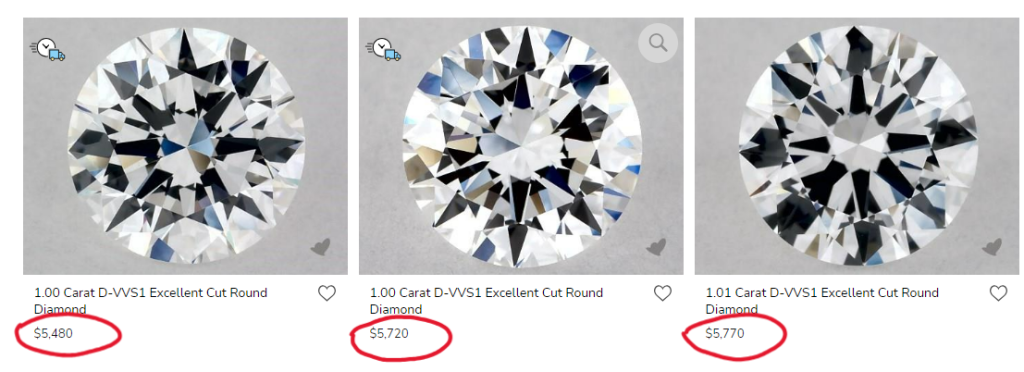
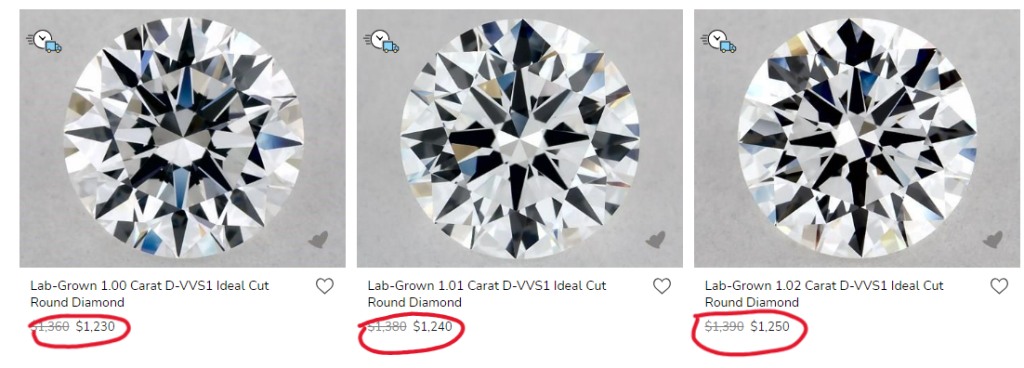
Prices have moved since these searches, but the buying lesson remains useful: compare equivalent specifications and the complete ring price rather than relying on a headline discount.
Earlier one-carat seller prices
Our earlier seller comparison used round lab-grown diamonds close to one carat, I–J color, VS1–VS2 clarity and the best available Excellent or Ideal cut grade.
| Jeweler | Recorded price range |
|---|---|
| Ritani | $401–$1,108 |
| Clean Origin | $411–$827 |
| Grown Brilliance | $485–$1,155 |
| With Clarity | $602–$2,159 |
| James Allen | $940–$1,250 |
| Brilliant Earth | $970–$1,840 |
Brilliant Earth's range included its seller-labeled sustainable collection. James Allen is now a collection at Blue Nile. The 2026 comparison above uses E color and VVS2 clarity.
Where to save—and where not to
| Decision | A sensible place to save | Do not compromise on |
|---|---|---|
| Cut | Compare seller labels and proportions before paying for the top label | A bright, even face-up appearance |
| Color | Try G–H before paying for D–F; warmer grades can suit yellow or rose gold | A color you notice and dislike |
| Clarity | Choose an eye-clean VS stone instead of automatically buying VVS | Inclusions that are visible or threaten durability |
| Carat weight | Compare stones just below 1, 1.5, 2 or 3 carats | Face-up measurements and proportions |
| Seller | Compare the same grades—and the same report number when possible | Returns, grading reports and dependable service |
| Setting | Choose a simpler design or a lower-priced metal | Secure prongs, workmanship and comfortable wear |
Seven ways to spend less on a lab-grown diamond
1. Set the total jewelry budget first
Price the finished ring, earrings or necklace—not only the loose diamond. Once lab-grown diamond prices become relatively low, the setting, metal and workmanship can represent a large part of the total.
For an engagement ring, decide how much you want to spend on the complete ring. Then divide the budget between the center diamond and the setting. This prevents an inexpensive stone from becoming an unexpectedly expensive purchase once a detailed setting is added.
2. Put cut and appearance ahead of high grades
Cut has the greatest effect on how lively a diamond looks. For round diamonds, start with strong cut grades and then inspect the video, proportions and grading report. For fancy shapes, seller labels are only a first filter; compare the outline, bow tie or dark areas, symmetry and face-up pattern yourself.
A bright G-color, VS2 diamond can be a better buy than a poorly cut D-color, VVS1 stone. The higher grades sound impressive, but they do not rescue a diamond that looks dull.
3. Buy eye-clean clarity
VS1 and VS2 are useful starting points because many diamonds in these grades look clean without magnification. Some SI1 diamonds can also be excellent value. Zoom in on the actual stone and check where the inclusions sit rather than rejecting or accepting it by grade alone.
Pay special attention to inclusions near pointed corners on princess, pear, marquise and heart shapes. Durability matters more than saving a small amount.
4. Be flexible on color
Most buyers do not need a D-color diamond. G or H often looks colorless once set, especially in a well-cut round. Yellow and rose gold can make slightly warmer grades an attractive value.
Fluorescence should not be treated as a reliable way to make a warm diamond look whiter. GIA says fluorescence usually has no widely noticeable effect on appearance. Judge the diamond itself rather than buying fluorescence as a shortcut.
5. Compare carat weight with face-up size
Prices can jump at familiar weights such as one, one-and-a-half and two carats. A 0.95-carat diamond may look virtually the same size as a one-carat stone, but the saving is only worthwhile if its dimensions and cut are competitive.
Compare length and width in millimeters. A deep diamond can hide weight below the setting and look smaller than a lighter, better-proportioned stone.
6. Compare more than one jeweler
The same diamond can appear in more than one virtual inventory, sometimes at different prices. When possible, search the grading-report number. Otherwise compare weight, measurements, color, clarity, cut, grading laboratory and the finished jewelry price as closely as you can.
Ritani is usually our first stop for low loose-diamond prices. Grown Brilliance is particularly useful for complete jewelry and setting design. Blue Nile—including the James Allen collection—offers a polished shopping experience, while Brilliant Earth and With Clarity add different setting and service options. Brilliance.com can be a useful secondary price check because its searchable inventory is very large, but our Brilliance.com review found that value and return terms vary enough to compare each listing carefully.
Read our Ritani review Compare diamonds at Ritani
7. Use genuine offers, not inflated savings claims
A sale can be worthwhile when it reduces the price of the jewelry you already wanted. Check what the offer covers, whether a code is required, and whether the discount applies to the diamond, the setting or only selected designs.
Our current lab-grown diamond deals are checked against seller terms. Compare the final price after the promotion instead of choosing the largest advertised percentage.
Compare prices for your preferred carat weight
Our carat guides include the complete seller tables, the diamonds we looked for, fancy-shape comparisons, jewelry examples and earlier prices. Use the guide closest to your target weight before choosing a stone.
- One-carat lab-grown diamond prices
- Two-carat lab-grown diamond prices
- Three-carat lab-grown diamond prices
Our bottom line
Start with the look you want, then lower color, clarity or carat weight one step at a time until the price fits. Keep the better-looking diamond when two certificates are close. Saving money is useful only when you still love the finished piece.
For most buyers, our practical starting point is a well-cut, eye-clean lab-grown diamond around G–H color and VS1–VS2 clarity. It is a starting point, not a rule: the actual video, dimensions, report and setting should decide the purchase.
How we compare prices
We compared loose round diamonds close to each target weight, using E color, VVS2 clarity and high cut grades. Where at least five close results were available, we used the middle of the five lowest prices. We then calculated the typical price from one benchmark per seller, keeping each jeweler equally weighted. Prices were checked between August 30 and September 3, 2026.
Questions and experiences
Join the discussion
Ask a question or share your experience. We review comments before publishing them.