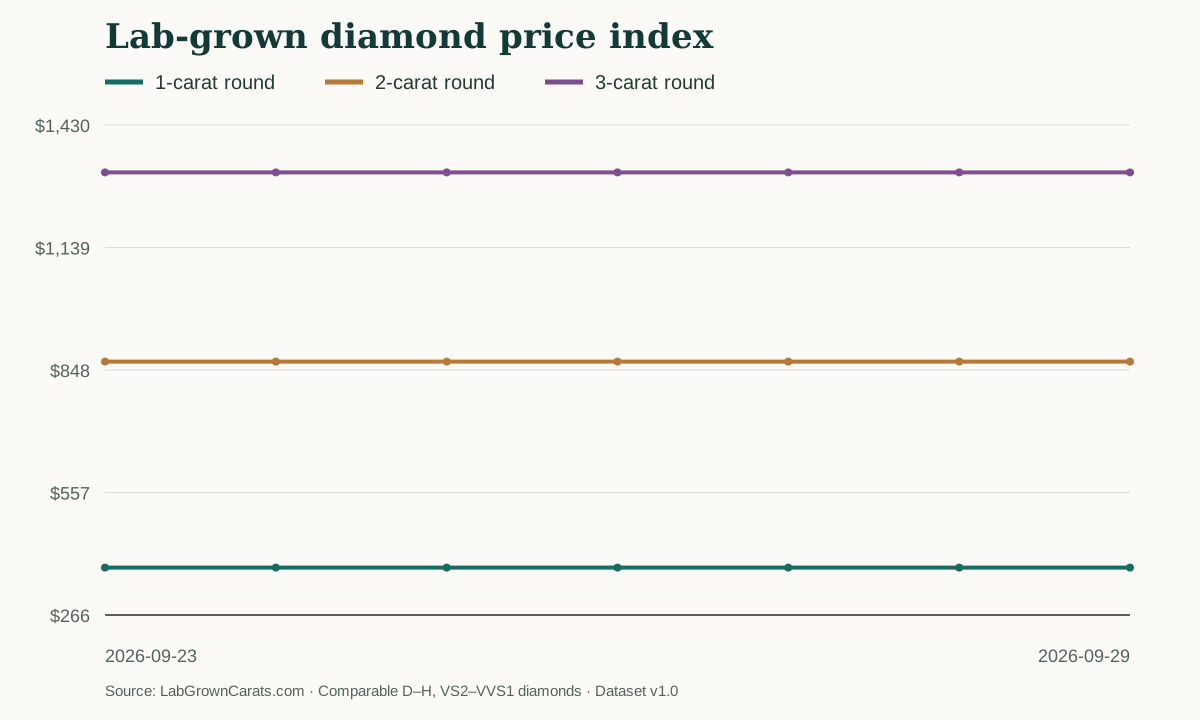
A regularly updated view of what comparable lab-grown diamonds cost across multiple jewelers—not a headline discount or one unusually cheap listing.
Latest market check:
Lab-grown diamond prices can move quickly as production, inventory, and retailer pricing change. We track comparable lower-priced round diamonds at one, two, and three carats to show a dated shopping benchmark and the direction prices are moving over time.
The index is designed for comparison shopping. It does not use a seller's crossed-out list price, combine unrelated quality grades, or let one unusually cheap diamond define the market.
Latest recorded lab-grown diamond prices
Each row shows its own check date. A figure remains the latest recorded benchmark until the next qualifying check, rather than a live quote.
These figures represent realistic lower-priced examples that met the same broad quality rules at multiple jewelers. They are loose-diamond prices before a ring setting or other jewelry is added.
Round diamond
Latest recorded benchmark
Checked
Movement in this report
Latest coverage
1-carat
$379
12.8% lower
3 jewelers · 1,892 qualifying listings
2-carat
$868
22.1% lower
3 jewelers · 2,917 qualifying listings
3-carat
$1,317
28.2% lower
3 jewelers · 2,767 qualifying listings
Daily market check
How lab-grown diamond prices are moving
We track comparable round lab-grown diamonds from our partner inventories. Each daily figure gives every seller equal weight, so one jeweler's unusually large catalog cannot dominate the market number.
1-carat round diamonds
$379
Typical lower-priced examples · checked Nov 8
Typical lower-priced examples are 12.8% lower than at the first of these 45 dated checks.
2-carat round diamonds
$868
Typical lower-priced examples · checked Nov 8
Typical lower-priced examples are 22.1% lower than at the first of these 45 dated checks.
3-carat round diamonds
$1,317
Typical lower-priced examples · checked Nov 8
Typical lower-priced examples are 28.2% lower than at the first of these 45 dated checks.
We first find a typical lower price at each jeweler for comparable D–H, VS2–VVS1 diamonds with strong cut grades. We then use the middle seller result, so every jeweler counts once regardless of inventory size. Latest check: Nov 8.
How to use this report
Use the figures as a realistic starting point, then compare the exact diamond's cut, measurements, color, clarity, grading report and video. Two diamonds with the same headline grades can still look different.
Our market number gives each participating jeweler equal weight. This prevents a seller with hundreds of thousands of listings from dominating the result and keeps the comparison closer to the choices a shopper actually has between stores.
What the report includes
Round lab-grown diamonds close to one, two and three carats
D–H color and VS2–VVS1 clarity
Excellent or Ideal cut grades supplied by the jeweler
In-stock inventory at collection from at least two jewelers for every published daily point
We use the grades supplied by each jeweler. If a listing does not name a grading laboratory or provide its report, ask the seller for it before buying.
How we calculate the price index
For each jeweler with at least three matching listings, we look at up to five of the lowest-priced diamonds that pass the same carat, shape, color, clarity, cut, stock, and freshness checks. We use the middle price from that small group as the jeweler's benchmark, so one unusually cheap listing does not decide the result.
We then give each qualifying jeweler one equal place in the daily market comparison. A store with a much larger feed therefore cannot outweigh every other seller. We publish a daily point only when at least two jewelers qualify.
Prices come from authorized jeweler inventory feeds and are normalized in US dollars. The live refresh stores non-personal product observations and retains dated benchmarks, allowing this report to show movement instead of replacing yesterday's price.
Download the price data and chart
The public dataset contains one row for each date, shape, and carat benchmark shown by this report. The CSV is easiest to use in a spreadsheet; the JSON preserves the same series for developers; and the SVG is a self-contained chart suitable for presentations and articles.
Dataset fields: observation date, shape, carat weight, benchmark price in US dollars, participating jeweler count, qualifying listing count, and dataset version. Version 1.0 uses the methodology described above. We will increment the version if the meaning of a field or the calculation method changes.
Listing counts reflect retailer inventory records. The same physical diamond can be offered by more than one seller.
The benchmark is a starting point, not a substitute for inspecting the diamond. Compare proportions, measurements, fluorescence, grading report, video, return terms, and the complete jewelry price. Inventory can also change between our check and yours.
How to cite this report
When referencing the figures, cite LabGrownCarats Lab-Grown Diamond Price Index and Market Report, include the latest market-check date shown above, and link to this page. The date matters because the underlying inventory changes frequently.